


Value-added warehousing is what separates a warehouse that only stores your products from one that actively makes them easier to sell, ship, and create a memorable unboxing experience. E-commerce has doubled its share of retail over the past decade. Simply holding inventory is no longer enough. The warehouse itself has to add value to the delivered package.
This article explains the model, the services behind it, and seven practical ways it can strengthen distribution, helping you decide whether it’s the right route for your brand’s next stage of growth.
TL;DR
- Value-added warehousing layers kitting, custom packaging, labeling, quality control, and returns onto standard receiving and shipping.
- The goal is efficiency and a stronger delivery, not just a place to park stock.
- Seven benefits: cost, speed, brand experience, order value, simpler operations, inventory control, and returns.
- Best fit: growing brands whose volume, SKU count, or packaging needs have outgrown a basic setup.
What Is Value-Added Warehousing?
Value-added warehousing pairs core storage and fulfillment with extra services that raise the value of goods before they reach the customer. Warehouses routinely provide logistics services such as labeling, light assembly, packaging, and pick and pack alongside storage. When those services are tied to the outbound movement of goods, the model is usually called value-added warehousing and distribution (VAWD).
➡️ Standard warehousing keeps inventory at rest.
⭐ Value-added distribution gets it market-ready with the finishing work already done. Orders are kitted, packed, labeled, and checked.
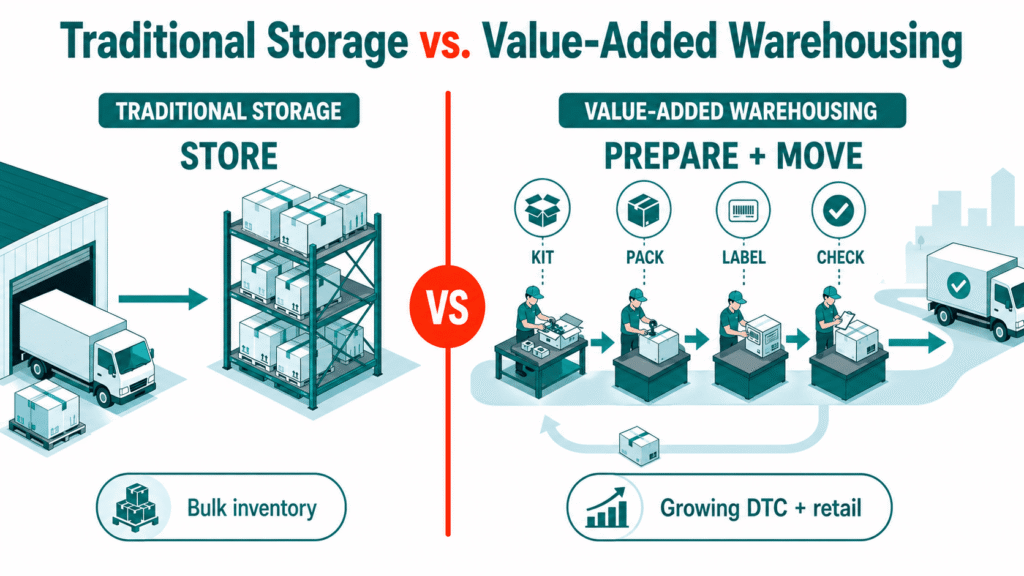
*Because this finishing work sits inside the flow of goods, it is often grouped under the wider heading of value-added logistics: the value-adding steps that happen between receiving and the customer’s door.
5 Common Value-Added Services In A Warehouse
- Kitting & Assembly: Combine multiple SKUs into one ready-to-ship unit, such as bundles, gift sets, or subscription boxes. (Our guide explains the kitting process in full.)
- Custom Packaging & Inserts: Branded boxes, tissue, and thank-you notes that shape the unboxing moment.
- Labeling & Compliance: Retailer-specific or regulatory labels applied before dispatch, a step that matters most in retail fulfillment.
- Quality Control & Rework: Inspection and correction so defects are caught before an order ships.
- Returns & Reverse Logistics: Receiving, inspecting, and dispositioning returned goods to recover value.
📌 Not every brand needs every service. The point is to add only the steps that move a real metric, like cost per order, on-time ship rate, or return rate.
Value-Added Warehousing vs Traditional Storage
| Factor | Traditional Storage | Value-Added Warehousing |
|---|---|---|
| Focus | Holding inventory | Enhancing goods and moving them |
| Typical Services | Receive, store, ship | Kitting, packaging, labeling, QC, returns |
| Measured By | Cost per sq. ft., accuracy | Cost per order, on-time ship, experience |
| Best Fit | Bulk, slow-moving stock | Growing DTC and retail brands |
7 Benefits Of Value-Added Warehousing In Distribution
Done well, value-added warehousing gives your distribution firmer footing. Here are seven benefits that show up directly in cost, speed, and customer trust.
- Lower cost per order. Consolidating SKUs through kitting, right-sizing cartons, and pre-building bundles cuts touches, labor, and dimensional weight, so each order costs less to move.
- Faster, accurate fulfillment. Pre-verified kits and quality checks at pick and pack mean fewer errors and quicker dispatch, so orders leave the dock safely, efficiently, and on time.
- Stronger brand experience. Custom packaging, inserts, and branded presentation turn a delivery into a moment customers remember and share, reinforcing loyalty across every channel through consistent omnichannel fulfillment.
- Higher order value. Bundles, gift sets, and promotional kits lift average order value and let you launch offers without re-tooling your own operation.
- Simpler operations. Folding storage, kitting, labeling, shipping, and returns under a single value-added logistics partner replaces a tangle of vendors with one accountable operation.
- Tighter inventory control. A modern warehouse management system (WMS) gives real-time counts across locations, so you can set smarter reorder points, avoid stockouts, and free up cash tied in stock.
- Smoother returns. Structured returns processing gets sellable items back on the shelf fast. That’s important, since U.S. retail returns topped $740 billion in a single year and global ecommerce returns exceed $640 billion annually.
Taking Your Brand Confidently Across Borders
Cross-border growth adds a steeper logistics climb. Every destination brings its own customs rules, product standards, language needs, and labeling requirements. Value-added warehousing prepares orders market by market, adapting packaging and documentation before dispatch while giving international returns a defined route home. The result is a more consistent brand experience across borders, with fewer compliance delays and less costly rework.
What Should Your Value-Added Service-Level Agreement Cover?
- Turnaround Times: Set deadlines for receiving, value-added work, order release, and urgent requests.
- Quality Thresholds: Define acceptable defect, damage, and rework rates with clear measurement rules.
- Inventory Accuracy: Set permitted variance, count frequency, reconciliation steps, and loss ownership.
- Peak Capacity: Lock in labor, space, and throughput before seasonal demand starts climbing.
- Change Control: Require written approval for revised instructions, materials, pricing, or deadlines.
- Exception Escalation: Name decision-makers, response windows, and a clear path around blockers.
- Performance Reporting: Agree on metrics, reporting frequency, review meetings, and corrective-action tracking.
- Missed Commitments: Define service credits, remediation, liability, and who ultimately holds the rope.
When Value-Added Warehousing Pays Off
These services are not free. That means that they need to justify their cost by bringing in results. The model pays off when the work they replace is already costing you more in time, errors, or lost sales. If your team is hand-assembling bundles, reprinting mislabeled cartons, or letting returns pile up, those are signals.
It also pays off when packaging and presentation are part of how you compete, or when retailer and marketplace rules demand exact labeling you cannot easily handle in-house.
💡 A quick test: List the finishing steps between an order and a shipped box, then price the ones your own staff performs today. If a specialist can do them cheaper, faster, or more accurately, the math usually favors outsourcing.
Turn Storage Into A Distribution Advantage With Agile
Agile brings warehousing, kitting, multi-carrier shipping, and returns under one roof, with real-time inventory visibility and two-day dock-to-stock receiving. Instead of “stitching vendors together”, you get one team turning value-added work into a lower cost per order and a cleaner customer experience. Exactly the footing you need to reach your next summit.
FAQs
What Is Value-Added Warehousing And Distribution?
It is warehousing that adds services like kitting, packaging, labeling, and returns, then ties them to outbound shipping, so goods leave the facility enhanced, order-ready, and safely moving toward the customer.
What Are Value-Added Services In Warehouse Operations?
Common value-added services include kitting and assembly, custom packaging and inserts, labeling and compliance, quality control, rework, and returns handling. Each adds value to the product or the order before it ships to the buyer.
How Is Value-Added Warehousing Different From A Standard 3PL?
A standard 3PL covers receiving, storage, and shipping. Value-added warehousing layers finishing services such as kitting, packaging, quality control, and returns on top, so the warehouse actively improves the product and the post-purchase experience.
Is Value-Added Warehousing Worth It For A Smaller Brand?
Often, yes. If bundling, branded packaging, or returns are eating your team’s time, value-added services logistics providers can absorb that work, lower your cost per order, and free up your team’s time so that they can focus on marketing, sales, and growth.
What Does Value-Added Warehousing Improve Most?
Usually cost per order, fulfillment speed and accuracy, and the returns experience. The right mix depends on your products and channels, which is why these services are designed to be selected, not bought as one fixed bundle.
When Should A Company Choose Value-Added Warehousing Over Basic Storage?
Consider it when manual finishing work is slowing orders, creating errors, or pulling your team away from growth. A value-added partner brings those steps into one coordinated flow, giving you the labor, systems, and capacity to scale without building a more complex operation in-house.