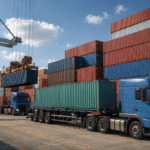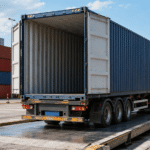



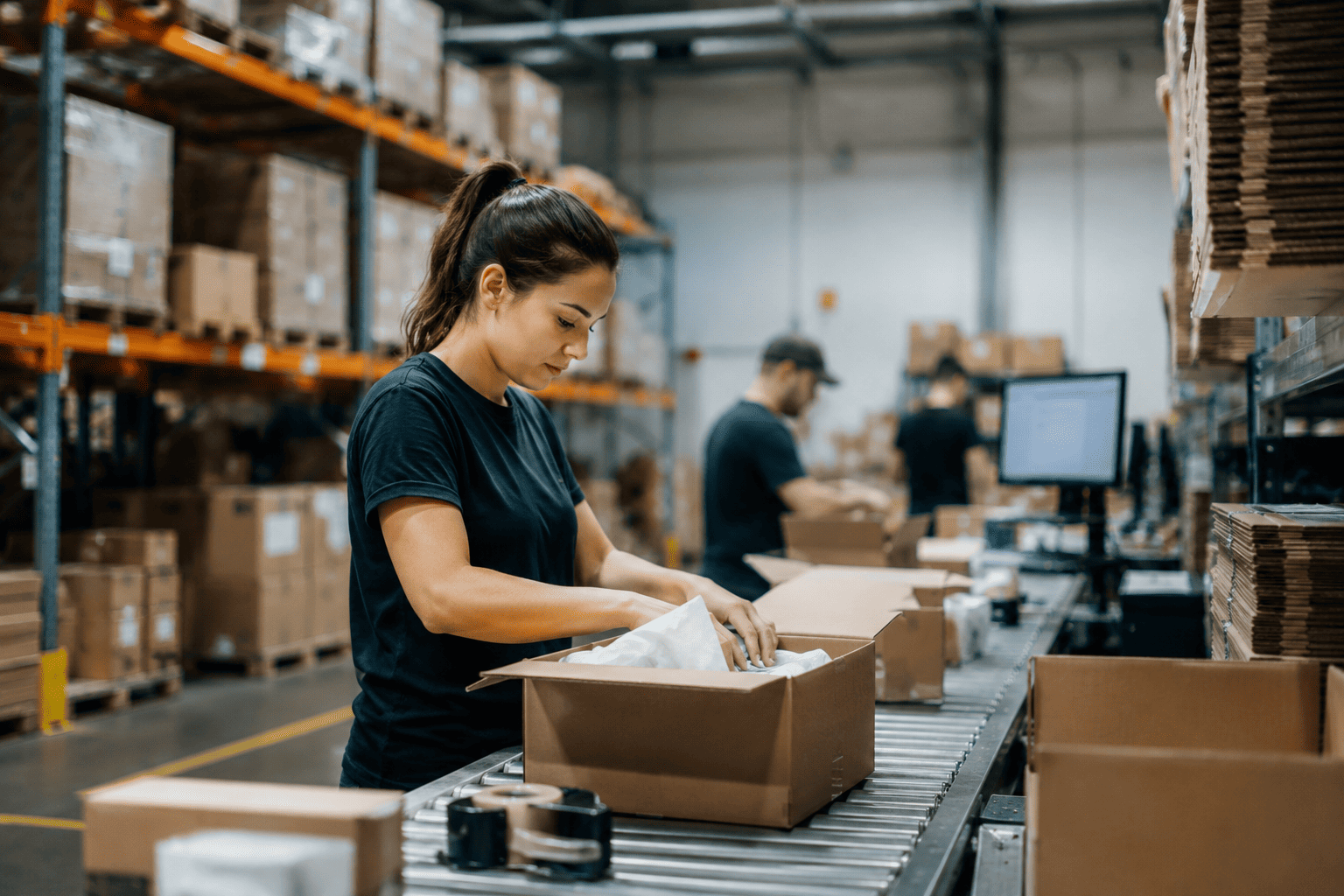
Order fulfillment looks simple from the outside: pick, pack, and ship. That’s it! Inside a growing brand, though, it becomes a tangle of warehouse leases, carrier contracts, peak-season hiring, and software no one had time to evaluate properly. Outsourced fulfillment is the operational decision to hand that tangle to a partner who already runs the playbook every day, so your team can keep building the brand instead of running the loading dock.
This article breaks down what outsourced fulfillment actually means, when it pays off, what to compare it against, and what to look for in a partner before you sign.
TL;DR
- Outsourced fulfillment hands off inventory storage, picking, packing, shipping, and returns to a third-party logistics provider (3PL) that already owns the warehouses, tech, and carrier relationships.
- The economics work when your in-house cost per order, real estate, labor, and software stack add up to more than a 3PL would charge.
- Scalability and shipping zones are the two biggest hidden wins: a multi-node 3PL network puts inventory closer to your customers and absorbs volume spikes without you having to hire.
- In-house still makes sense when products are made-to-order, regulated, fragile, or volume is genuinely low.
- Vet for retail fit, technology depth, visibility, and SLAs. The wrong partner is more expensive than staying in-house; the right one becomes a quiet competitive advantage.
What Exactly Does Outsourcing Mean?
Outsourced fulfillment is the practice of hiring a third-party logistics company (a 3PL) to manage some or all of the order fulfillment process: receiving inventory, storing it, processing orders, picking and packing, shipping, and handling returns. The 3PL owns the warehouses, the warehouse management system, the carrier contracts, the labor, and the materials.
The defining trait of outsourcing fulfillment is that the provider serves many brands at once while customizing the experience (packaging, inserts, SLAs) so the end shopper still has a seamless brand experience. That shared infrastructure is exactly what makes the model cost-effective. Establishments, equipment, and headcount are spread across many clients rather than sitting idle on your balance sheet between peaks.
A Few Terms Worth Defining Up Front
- Outsourced order fulfillment: the broader process of letting a partner manage some or all of order processing through delivery.
- Outsourced warehousing: the storage piece specifically; a partner houses your inventory in their facility.
- Outsourced warehousing and distribution: storage plus the outbound shipping operation that moves goods from the warehouse to the customer.
- Outsourced warehousing and fulfillment: storage plus the full pick/pack/ship operation.
- Order fulfillment outsourcing or fulfillment outsourcing or outsourced fulfillment: different phrasings of the same concept.
Different vendors slice this differently, but the underlying idea is consistent: a specialist takes on the operational climb of getting orders to customers safely, efficiently, and on time, so you can spend your attention elsewhere.
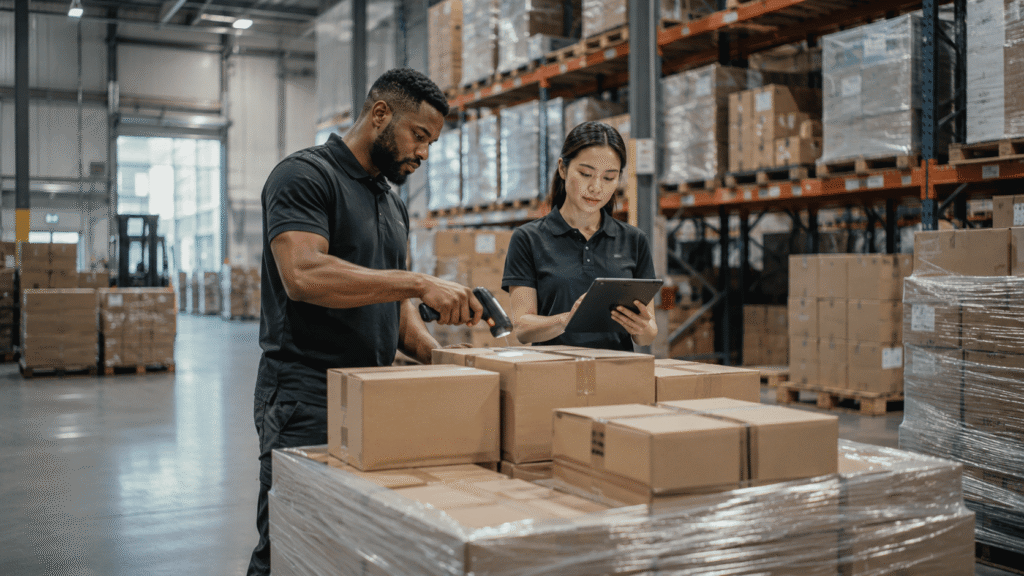
Outsourcing Fulfillment vs In-House Fulfillment
There are really only two ways to fulfill an order: do it yourself or hand it to a partner. The trade-off is control versus leverage.
In-house fulfillment means you own the warehouse lease, the racking, the WMS, the forklifts, the dock workers, the seasonal hires, the carrier contracts, the packaging supply chain, and every operational failure that happens between an order landing and a customer opening the box. You also get total control over the experience. This approach is useful if your product is fragile, hand-finished, or the unboxing is genuinely part of the brand.
Outsource fulfillment means you trade some of that hands-on control for a partner whose entire business is structured to deliver your packages following tested workflows. You get their carrier rates, their multi-node footprint, their inventory and order tech, and their ability to scale labor up and down without you carrying the cost between peaks.
Here’s how the two compare:
Outsourcing Fulfillment vs In-House Fulfillment Comparison
| Factor | In-House Fulfillment | Order Fulfillment Outsourcing |
| Upfront Investment | Warehouse lease, equipment, WMS, hiring | Set up and integration fees only |
| Cost Structure | Largely fixed | Largely variable, per-order |
| Scalability | Limited by your space and headcount | Scales with the 3PL’s network |
| Shipping Rates | Your own carrier contracts | The 3PL’s negotiated rates |
| Geographic Reach | Single facility unless you build more | Multiple fulfillment centers, lower zone charges |
| Technology | Whatever you buy and maintain | Included: WMS, OMS, reporting, integrations |
| Control Over Experience | Total | High, but inside the 3PL’s process |
| Best For | Made-to-order, regulated, low-volume brands | Growing DTC, omnichannel, multi-region brands |
💡 The honest answer is that most growing brands eventually hit a point where the in-house column becomes the more expensive one, even though it doesn’t look that way on a P&L. That tipping point is the moment outsourcing starts making sense.
6 Reasons Why Brands Outsource Fulfillment
There are several reasons brands move to outsourced ecommerce fulfillment, and they tend to stack. Most operators don’t switch because of one of them. They switch because four or five are true at once.
1. You Stop Owning Storage
Your sales fluctuate. Warehouse space doesn’t. Outsourcing e-commerce fulfillment moves inventory into a shared facility where you pay for the space you use, not the space you might use during peak. Warehouse rental rates have climbed in recent years, and locking in a long-term lease ahead of growth that may or may not arrive is one of the riskier bets a growing brand can make.
2. You Stop Running A Warehouse
Calculate this: Boxes, dunnage, label printers, and the trip to the carrier multiplied across thousands of orders. Beyond the daily grind, leasing and operating a fulfillment space means staffing, equipment, insurance, and software. Outsource order fulfillment, and you replace that overhead with a per-order cost.
3. You Free Up The Team For What Only You Can Do
Time is the resource that gets eaten quietly. Outsourcing fulfillment lets the founder and operating team spend their hours on brand, product, and growth; the work that no 3PL can do for you. Inventory management, packing, and shipping are the 3PL’s core business. Brand and product are yours.
4. You Get Volume-Based Carrier Rates
A 3PL ships for hundreds of clients. That volume gets translated into carrier discounts and delivery options that no single mid-sized brand could negotiate alone. For most growing brands, the carrier savings alone justify a meaningful share of the 3PL cost.
5. You Inherit The Technology Stack
WMS, OMS, real-time inventory visibility, order routing, reporting; they’re all included. Outsourced order fulfillment partners invest continuously in technology because it’s how they compete. You inherit that investment instead of trying to fund it from your own roadmap.
6. You Get Scalability In Both Directions
When volumes go up, a good 3PL absorbs it. When volumes go down, like a slow quarter, a category shift, you’re not stuck paying for a warehouse and a workforce sized for last year’s plan. Outsourcing warehouse operations to a partner converts a fixed cost into a flexible one.
When Outsourcing Order Fulfillment Is The Right Call
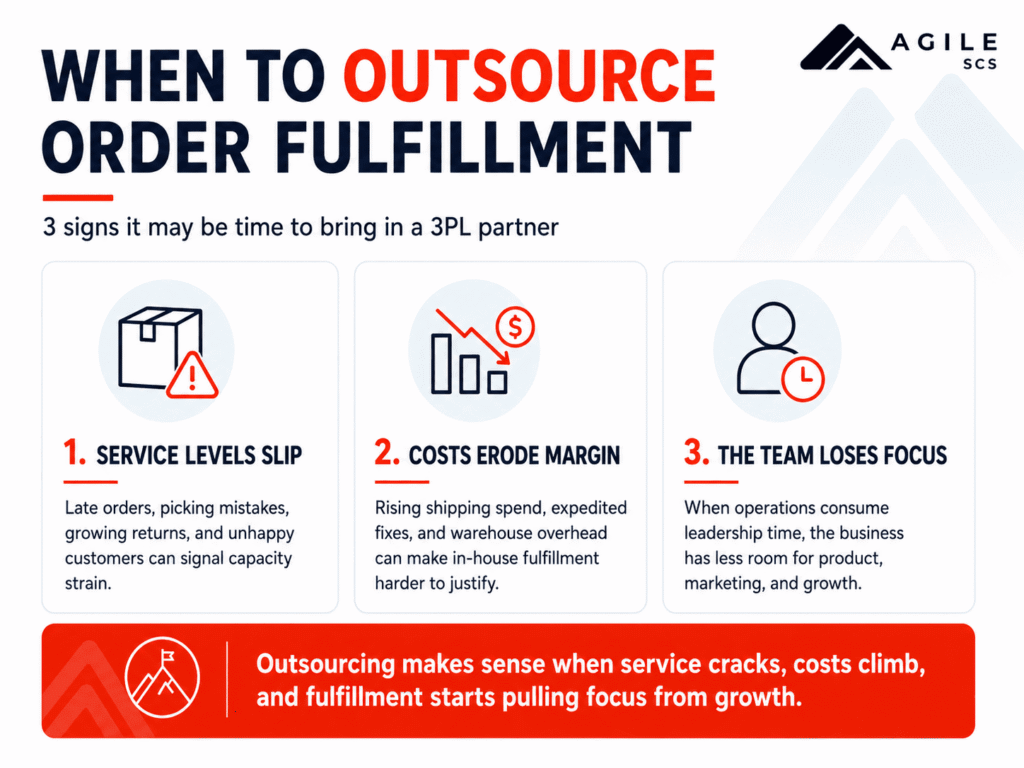
Three signals usually mean it’s time to look seriously at fulfillment outsourcing:
- Service levels are slipping. Late shipments, picking errors, customer complaints, returns piling up… Operational quality is the first thing to break when volume outgrows in-house capacity.
- Fulfillment costs are eating into the margin. Long-zone ground shipments, expedited air to fix late orders, warehouse rent that keeps creeping up. A partner with better carrier rates can usually rebuild the math around your logistics framework.
- Fulfillment is distracting the team from the business. When the founder is troubleshooting a label printer at 9 PM, the company isn’t growing. Outsource shipping, and you get those hours back for product, marketing, and customers.
When To Keep Fulfillment In-House
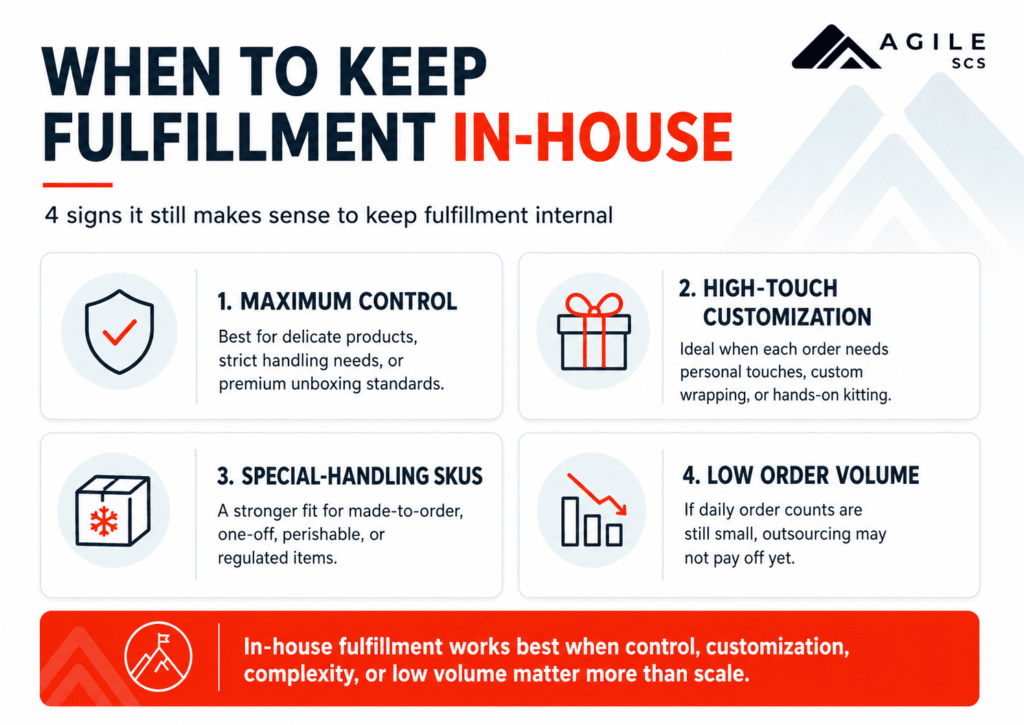
Outsourcing isn’t always the answer. Stay in-house when:
- You need total control over how items are stored, picked, packed, and shipped — usually because the product is fragile, handmade, or the unboxing experience is priority number one.
- Personalization is part of every order. Handwritten notes, custom gift wrap, intricate kitting that isn’t repeatable at 3PL scale. Many 3PLs handle branded packaging and basic kitting, but heavy per-order customization is harder.
- Your SKUs are unusual; made-to-order, one-of-a-kind, perishable, hazardous, or flammable. Some of these can’t be outsourced at all; others require a specialist 3PL.
- Volume is genuinely low. If you can pack today’s orders before lunch, the math for e-commerce fulfillment outsourcing doesn’t work yet.
Build A Smarter Fulfillment Strategy With Agile
Growth changes the terrain. The fulfillment setup that worked at $5M starts cracking at $20M, and the one that holds up at $20M won’t survive the next 50% of your growth.
Outsourced fulfillment done well is not just handing your operation to a vendor. At least, not only that. It is building the right operational partnership; one that protects accuracy, creates flexibility, and keeps your brand moving safely toward the next summit.
At Agile, we run two-day dock-to-stock, multi-carrier rate shopping, cartonization, and packaging right-sizing to lower cost per order without hurting speed or the customer experience.
We onboard most clients in two to six weeks, with clear milestones, data validation, and test orders before the first live shipment. And we treat KPIs and SLAs as commitments, because we succeed only when you succeed.
FAQs
What Is Outsourced Fulfillment?
Outsourced fulfillment is when a business partners with a third-party logistics provider to handle some or all of its order fulfillment, like storing inventory, processing orders, picking and packing, shipping, and managing returns. The 3PL provides the warehouses, technology, labor, and carrier relationships, and operates as part of the brand’s partner network. The goal is a faster, more reliable, and more cost-efficient operation than the brand could run on its own.
What Exactly Does Outsourcing Mean?
Outsourcing means hiring an external partner to perform a function your business would otherwise do in-house. In fulfillment, that usually means letting a specialist 3PL run the warehouse, the picking and packing, the shipping, and often the returns flow. The brand stays accountable for the customer experience, but the operational execution sits with the partner.
What Are The Four Types Of Fulfillment?
The four common models are: in-house fulfillment, where the brand owns and runs everything; dropshipping, where the supplier ships directly to the customer; 3PL fulfillment, where a third party handles storage, picking, packing, and shipping; and hybrid fulfillment, which combines two or more models; for example, in-house for personalized orders and a 3PL for standard SKUs.
What Are The 4 Types Of Outsourcing?
In a fulfillment context, the four main outsourcing options are: niche fulfillment providers that specialize in a vertical such as apparel, electronics, or cold chain; standard 3PL companies that offer receiving, storage, picking, packing, and shipping; 4PL or cowarehousing providers that aggregate volume across multiple brands to negotiate better rates and SLAs; and full-service partners that combine fulfillment with transportation management, returns, technology, and customer care.
Which 3PL Is Best For Ecommerce Order Fulfillment?
The best fit depends on your size, mix, and trajectory. Agile supports direct-to-consumer and wholesale brands that are ready for a more structured fulfillment operation, with the space, systems, and expertise to keep growth moving, without the rigid contracts and minimums that come with enterprise-only providers. If your operation is getting too complex to run from a spreadsheet, that’s the right moment to talk.
What Should Businesses Evaluate When Deciding To Outsource Fulfillment?
Start with your current fully-loaded cost per order, including warehouse rent, labor, packaging, software, management overhead, and the hidden costs of seasonal staffing, training, and turnover. Compare that against a quoted 3PL rate, but also factor in growth aspirations, peak capacity needs, geographic distribution of customers, current shipping speeds and costs, and any special handling requirements. The right time to switch is usually when fulfillment starts consuming resources that should be funding growth.