


Warehousing and distribution are two halves of the same supply chain that quietly do very different jobs. One keeps your inventory safe, organized, and ready. The other gets it out the door and into a customer’s hands on time. They share buildings, software, and people, which is exactly why operators blur them together, and why the costs tend to hide in the gaps between them.
That distinction matters more as you grow. With U.S. e-commerce reaching 16.4% of all retail sales in 2025, the handoff from shelf to doorstep has become a core part of how brands compete. Knowing where storage ends and movement begins is the firmer footing every scaling brand needs.
This guide breaks down what each function actually does, the real difference between warehouse and distribution center operations, and how to run both as one connected system rather than two disconnected cost centers.
TL;DR
- Warehousing is storage: receiving, organizing, and protecting inventory until it’s needed.
- Distribution is movement: picking, packing, and shipping goods to retailers, wholesalers, or consumers.
- One holds, one flows: warehouses optimize for storage density, distribution centers for throughput and speed.
- They monitor different KPIs: cost per square foot versus cost per order and on-time ship rate.
- Disconnect the two, and you get delays, errors, and trapped cash.
- The optimal setup is situational. The right mix depends on your volume, SKU count, and delivery promises.
What Is Warehousing?
Warehousing is the receiving, storage, and management of goods inside a dedicated facility. A warehouse is, at its simplest, a structure for storing merchandise, but in a modern supply chain, it does far more than hold boxes. It receives inbound shipments, records and slots inventory, tracks stock levels, and prepares goods for their next move. It’s also a large and growing part of the U.S. economy.
Warehouse Types
Warehouses come in several forms, depending on what you store and how long you store it for:
- Public warehouses rent space to multiple businesses, offering flexibility without a long lease.
- Private warehouses are owned by or dedicated to a single company and tuned to its exact needs.
- Bonded warehouses hold imported goods under customs control until duties are paid.
- Specialized warehouses handle temperature-sensitive, hazardous, or seasonal inventory.
The work is tracked by a warehouse management system (WMS), the software that keeps stock counts accurate and tells the team where every SKU (stock-keeping unit) lives. Warehousing is measured by inventory accuracy and storage efficiency, not speed.
What Is Distribution?
Distribution is the stage that moves finished goods from storage to their final destination: a retailer, a wholesaler, or the end consumer. Warehousing keeps inventory secure. Distribution gives it momentum, moving products safely, efficiently, and on time through the channels that lead to your buyers.
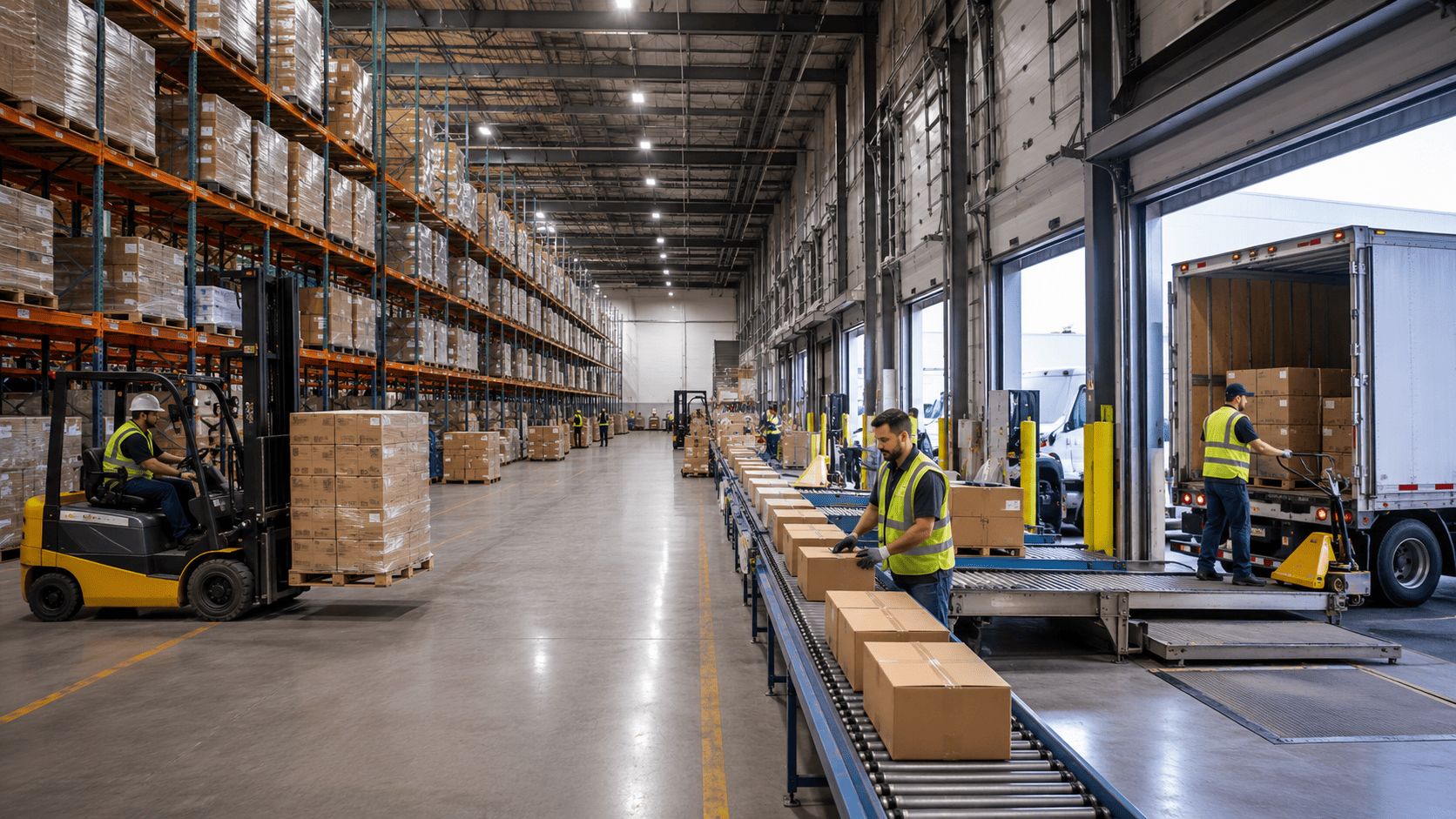
A distribution center (DC) is the facility built for that movement. It still stores goods, but only briefly: products arrive, get picked and packed against live orders, and ship out fast. Many DCs are run by a third-party logistics (3PL) provider that manages storage, fulfillment, and carrier handoffs as a single service.
Distribution also covers the choices behind the movement: which channel to use, which carrier, which route, and which service level. Those decisions shape your delivery speed and your shipping cost in equal measure.
➡️ The simplest way to remember it: warehousing manages inventory at rest; distribution manages inventory in motion.
Warehousing vs Distribution: Key Roles & Differences
The clearest way to see the warehouse vs distribution center split is to compare them side by side. Both store goods and both run on a WMS, but they’re optimized for opposite outcomes: one for holding, one for flow.
| Aspect | Warehouse | Distribution Center |
|---|---|---|
| Primary Role | Long- or short-term storage | Rapid order processing and shipping |
| Inventory Dwell Time | Longer; goods may sit for weeks | Short; high turnover |
| Core Activities | Receiving, storing, inventory control | Picking, packing, cross-docking, shipping |
| Optimized For | Storage density and accuracy | Throughput, speed, and order accuracy |
| Customer Contact | Minimal | Direct link to fulfillment and delivery |
| Key Metrics | Inventory accuracy, cost per square foot | Cost per order, on-time ship rate |
📌 In everyday use, “warehouse” and “distribution center” are often used interchangeably, and plenty of facilities do both jobs. The difference is one of emphasis: storage-first versus shipping-first.
How Warehousing And Distribution Work Together
In practice, warehousing and distribution form one connected path from shelf to buyer. When the route is planned well, a strong storage and distribution operation pays off on a few key fronts:
- Inventory optimization: central storage balances supply against demand, preventing both stockouts and overstocking. Smart order thresholds, like a well-tuned minimum order quantity, keep inventory lean without starving fulfillment.
- Faster fulfillment: pick-and-pack processes and value-added work like kitting and assembly turn stored inventory into ready-to-ship orders.
- Location advantage: placing inventory closer to buyers cuts transit time and cost, and makes options like expedited shipping viable when an order runs late.
- Cost control: consolidating freight and using transportation management keeps cost per order down as volume rises.
- Network visibility: connected systems provide real-time stock and order data, which builds trust with the retailers and channels you serve.
As your order volume climbs, this handoff between shelf and shipment is where margin is won or lost. If you’re outgrowing in-house fulfillment, map your cost per order before you switch models. It’s the number that tells you whether outsourcing fulfillment will actually save money.
Build Warehousing And Distribution Into One Connected Operation
When storage and shipping run on separate systems, the gaps between them cost you in delays, errors, and cash tied up in the wrong stock. Agile brings both under one roof, pairing real-time inventory visibility with multi-carrier rate shopping, cartonization, and dedicated fulfillment services so your products move from manufacturer to customer without friction.
The result is a supply chain you don’t have to think about, and the operational confidence to reach your next summit.
Frequently Asked Questions
Are Warehouse And Distribution The Same?
No. A warehouse focuses on storing and managing inventory, while distribution focuses on moving it to its destination. Many facilities handle both, but they optimize for different goals: storage accuracy versus fast, accurate shipping.
What Is Amazon Warehousing And Distribution?
It refers to Amazon storing your inventory in its network and shipping orders on your behalf, most commonly through Fulfillment by Amazon (FBA). You send stock to Amazon’s warehouses, and it handles picking, packing, delivery, and returns.
What Are The Four Types Of Distribution?
The four common distribution strategies are direct, intensive, selective, and exclusive. They differ by how widely a product is made available, from selling straight to consumers to placing goods in as many outlets as possible, or limiting them to a few.
What Is An Example Of A Distribution Warehouse?
A regional distribution center for an apparel brand is a clear example. It receives bulk shipments from manufacturers, holds them briefly, then picks, packs, and ships individual online orders to customers across that region, often within a day or two.