


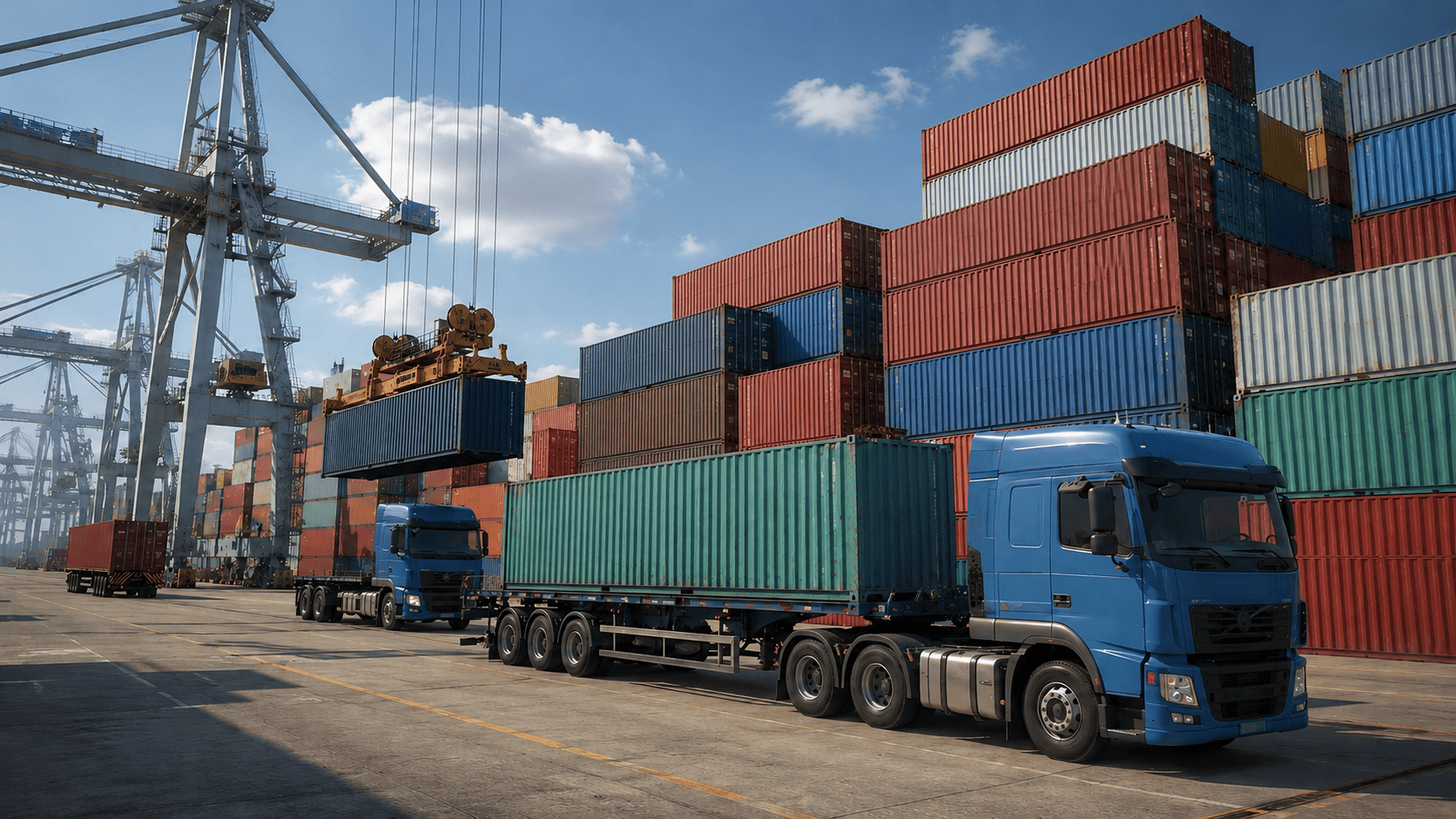
Drayage is the short-distance move that gets a shipping container from a port, rail yard, or terminal to its next stop (usually a warehouse, distribution center, or another carrier’s hub). It’s rarely the longest leg of a shipment, but it’s often the one that decides whether the rest of the journey stays on schedule.
Every container that crosses an ocean or rides a train still needs a truck for the final few miles, and that essential final-mile handoff is what drayage covers. Let’s break down the drayage meaning, the six classifications the industry uses to describe it, the equipment involved, and a real-world example of how it plays out at a U.S. port.
TL;DR
- Drayage moves containers over short distances, typically within one metro area, from a port or rail yard to a warehouse or another carrier.
- IANA defines six classifications: inter-carrier, intra-carrier, pier, shuttle, door-to-door, and expedited drayage.
- Drayage trucks run on a chassis, a wheeled frame carrying the container, under a shared equipment agreement called the UIIA.
- Drayage differs from cartage: drayage moves whole containers, while cartage moves break-bulk freight already unpacked and split across stops.
- Common charges include fuel surcharges, chassis fees, congestion fees, and per diem charges once a container sits past its free time.
- On-dock rail at major ports is quietly reducing drayage volume by letting containers transfer straight from ship to train.
What Is Drayage In Trucking & Shipping?
Drayage is the transport of a shipping container over a short distance, usually within a single metro area, as part of a longer intermodal journey. The term describes both the service and, sometimes, the fee charged for it. In other words, drayage is the connective link that moves a container onto its next mode of transportation without the freight inside ever leaving the box.
The word traces back to “dray”, a low, sideless cart once pulled by horses. Drayage was the work or cost of hauling by dray. Diesel trucks may have replaced the horses generations ago, but the short-haul job behind the term is still used today.
By this drayage definition, hiring a drayage service means paying for that connective short-haul leg, not the full door-to-door shipment.
Note: Drayage almost always refers to moving a sealed container. Once unpacked and split across multiple stops, the job is usually called cartage instead (more on that distinction below).
How Does Drayage Pricing Work?
A typical drayage shipment starts at a port, rail ramp, or trucking terminal and ends at a warehouse or another carrier’s facility. Because the distance is short, pricing works differently than long-haul freight: a drayage truck driver isn’t paid primarily by the mile, but by the time, equipment, and complexity of a single move.
How Drayage Operations Move Freight
Picture a container arriving at the Port of Savannah on a ship from Vietnam. It can’t reach a Midwest distribution center by ship or rail alone. You’ll have to move it off the dock somehow. This first handoff is drayage in action.
Most drayage operations follow a simple pattern:
- pick up a container at one facility,
- haul it a short distance,
- drop it at the next one.
A single container might need drayage two or three times before reaching its final destination:
- ship to rail ramp,
- rail ramp to warehouse,
- sometimes once more between carriers.
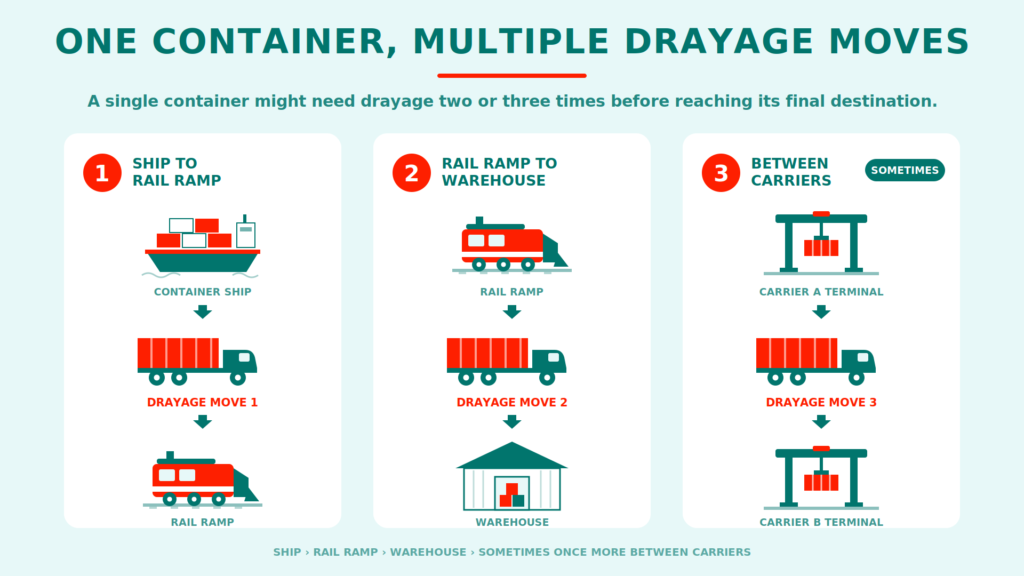
This is the connective role drayage plays within intermodal transportation, where a sealed container moves across truck, rail, and ocean legs without ever being opened.
On-Dock Rail Access In The U.S.
Not every move happens the same way. Some drayage shipments run through congested coastal ports with tight windows; others move through inland rail ramps with more flexibility.
Federal port data show that 16 of the top 25 U.S. container ports now have on-dock rail access, allowing containers to transfer straight from ship to train and eliminating a drayage move.
Growth changes the terrain, though. A single lane through one port can turn into a multi-port operation almost overnight, which is why many brands hand this coordination to a dedicated transportation management team.
Classifications Of Drayage
The Intermodal Association of North America organizes drayage into six standard classifications. Knowing which one applies to a given move affects pricing, scheduling, and which carrier is the right fit.
| Classification | What It Moves | Typical Use Case |
|---|---|---|
| Inter-Carrier Drayage | A container between two different carriers | A rail-to-truck handoff across town |
| Intra-Carrier Drayage | A container between two hubs owned by the same carrier | Moving between two rail yards under one network |
| Pier Drayage | A container between a rail terminal and an ocean pier | Getting cargo to or from the dock |
| Shuttle Drayage | A container to a temporary holding yard | Overflow storage when a hub runs out of room |
| Door-To-Door Drayage | A container directly to the end customer | Final-mile delivery for e-commerce or retail orders |
| Expedited Drayage | Time-sensitive drayage freight | Perishables or high-priority shipments |
📌 Container drayage is the term most people mean when they say “drayage,” referring to any of the six classifications above.
📌 Rail drayage specifically refers to moves connecting a rail ramp to another facility, common wherever a port doesn’t have direct on-dock rail access.
📌 Door-to-door drayage has grown alongside e-commerce, since more brands now need a container’s contents routed straight into their retail network, rather than a traditional wholesale distribution center.
Classification Of Vehicle Weight
Drayage Equipment: Trucks, Trailers & Chassis
Drayage trucking relies on specific equipment, which is a common source of confusion. A drayage truck is typically a Class 8 day-cab tractor, built for short, high-frequency runs rather than overnight hauls, since most drivers return home the same day.
What makes truck drayage distinct from other short-haul trucking is the equipment underneath the container: a drayage chassis, a skeletal wheeled frame built to carry intermodal containers rather than a standard dry-van drayage trailer.
Most drayage carriers don’t own every chassis they use. Instead, they participate in the Uniform Intermodal Interchange and Facilities Access Agreement (UIIA), allowing drivers to pick up chassis owned by railroads or leasing companies without renegotiating terms for each move.
The Federal Motor Carrier Safety Administration requires the companies that own this equipment to register as intermodal equipment providers and maintain it to federal safety standards.
Drayage vs Intermodal Transportation
These two terms get used almost interchangeably, but they describe different things. Intermodal transportation is the overall strategy of moving a sealed container across multiple modes (ship, rail, and truck) without unpacking it.
Put simply, drayage and intermodal transportation depend on each other. Neither a train nor a ship can pull up to a warehouse loading dock, so intermodal transportation simply couldn’t function without drayage.
Drayage vs Cartage: What’s The Difference?
Drayage vs. cartage is a more useful comparison, because the two terms genuinely describe different jobs:
✔️ Drayage moves a whole, sealed intermodal container between two points. The contents stay packed the entire time.
✔️ Cartage typically starts after that container has been unpacked at a warehouse or distribution center, then splits the freight into smaller loads for delivery to multiple local stops.
The equipment differs too:
✔️ Drayage relies on Class 8 tractors and container chassis built for standardized 20-, 40-, and high-cube containers.
✔️ Cartage more often uses smaller box trucks suited to tight city streets and multiple stops per shift.
Drayage Costs, Charges & A Real-World Example
Drayage pricing affects landed cost, but it isn’t calculated the way long-haul freight is. Because the distance is short and fixed, carriers price by time and accessorials rather than by the mile. This includes:
- Fuel surcharges that adjust with current diesel prices.
- Chassis fees for the use of rented equipment during the move.
- Congestion fees applied when port delays extend a driver’s time on-site.
- Detention or per diem charges once a container sits past its free time.
- Overweight fees, since federal law limits truck weight in three key ways: 20,000 pounds on a single axle, 34,000 pounds on tandem axles, and 80,000 pounds in total gross vehicle weight (tare weight included).
Example:
A 40-foot container of consumer goods is discharged at a West Coast port. A drayage carrier picks it up, hauls it 18 miles to a bonded warehouse, and returns the empty container before the free-time window closes, avoiding per diem charges entirely. If those goods later need to reach five retail stores in smaller, unpacked loads, that next step is cartage.
Port conditions can move these numbers quickly. In November 2024, U.S. container imports rose 14.7% year over year to 2.17 million TEUs, a reminder that drayage capacity can tighten quickly when import volumes pull forward. That volatility is one reason shippers lean on a 3PL service provider that already tracks lane-by-lane conditions.
Keep Your First And Last Mile As Reliable As The Rest Of The Route
Drayage may cover only a short stretch of the shipment, but it carries outsized risk. One missed appointment, overweight container, or delayed handoff can stop a load that has already traveled thousands of miles without issue. As order volume climbs and your network expands across more ports and rail ramps, keeping the first and final mile safe, efficient, and timely takes more than a single trucking contact. It takes a partner who knows the terrain well enough to support you throughout the ascent.
Agile coordinates drayage-adjacent transportation alongside warehousing, 4PL orchestration, and fulfillment, tracked through the same transportation management system that manages the rest of the shipment.
Ready to compare your current shipping setup against a full-route flow built for safer, faster movement?
Frequently Asked Questions
What Does The Term Drayage Mean?
Drayage refers to moving a shipping container over a short distance, typically within a single metro area, as one leg of a longer intermodal shipment.
How Do You Pronounce Drayage?
Drayage is pronounced “DRAY-ij,” rhyming with “dray” plus a soft “-ij” ending, similar to “storage” or “coverage.” Colin’s dictionary includes an audio pronunciation guide for both British and American English pronunciation, if you want to hear it spoken.
What Is The Difference Between Freight And Drayage?
Freight is the general term for any goods being transported, regardless of distance or mode. Drayage is one specific type: the short-distance, single-shift transport of a container between a port, rail yard, and nearby facility.
What Is A Drayage Charge?
A drayage charge is the fee billed for moving a container short distances, usually covering the base move plus accessorials like fuel surcharges, chassis rental, or congestion fees. Charges are typically flat or time-based rather than calculated per mile.
What Is Drayage vs Intermodal?
Intermodal transportation is the overall strategy of moving a sealed container across ship, rail, and truck. Drayage is the truck-based portion of that journey that connects the other modes.
What Is The Difference Between Cartage And Drayage?
Drayage moves a whole, sealed container between two points without unpacking it. Cartage usually begins after a container has been opened, splitting its contents into smaller loads delivered to multiple local stops within a city.