


TL;DR
- Amazon FBA is a fulfillment model where Amazon stores your products, ships orders, and handles returns and much of the customer service – while you keep ownership of sourcing, listings, pricing, and inventory planning.
- Its biggest advantages are operational simplicity, Prime eligibility, and the ability to scale without managing fulfillment in-house.
- As of January 1, 2026, Amazon no longer offers prep and labeling services – every shipment must arrive fully prepped and compliant, or you risk rejected inventory with no reimbursement.
- FBA is not always the best fit, especially for oversized, slower-moving, or lower-margin products where FBM may make more sense – and many sellers run both models side by side.
- Success with FBA depends on understanding the full fee structure, meeting Amazon’s requirements, and choosing the right fulfillment model for each SKU.
Fulfillment by Amazon (FBA) has transformed how brands scale on the world’s largest marketplace. But is it right for you? What are its pros and cons? This guide breaks down what Amazon FBA is, how it works, and its real costs, so you can grow without losing your brand’s footprint.
What Is Amazon FBA?
Fulfillment by Amazon (FBA) is a logistics model where Amazon manages storage, picking, packing, shipping, returns, and customer service for your products. Through the fulfillment by Amazon system, you send inventory into Amazon’s network, and Amazon handles execution.
How Does Amazon FBA Work?
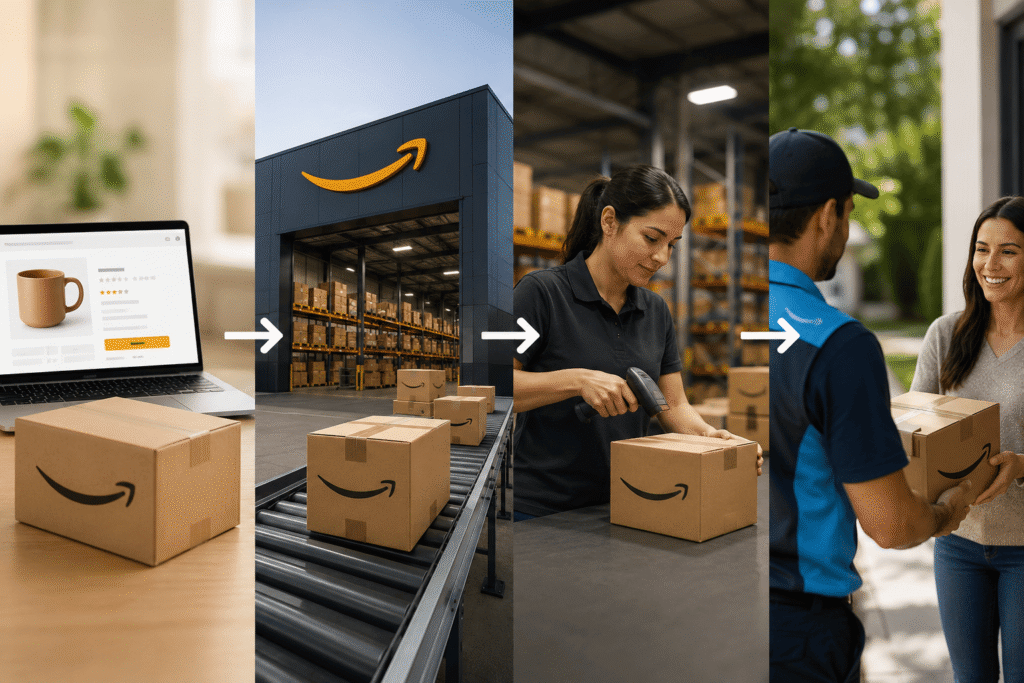
Amazon FBA follows a straightforward process. You send inventory to Amazon, Amazon stores it, and when a customer places an order, Amazon handles fulfillment and much of the post-purchase experience for you.
1. You Ship Inventory To Amazon
To begin, you enroll in FBA through Seller Central, prepare your products according to Amazon’s requirements, and send inventory to the fulfillment centers Amazon assigns.
2. Amazon Stores Your Products
Once received, Amazon places your inventory within its warehouse network and keeps it available for incoming customer orders.
3. A Customer Places An Order
When a shopper buys your product on Amazon, the order is automatically routed through Amazon’s fulfillment system.
4. Amazon Picks, Packs & Ships The Order
Amazon then handles the physical fulfillment process, including picking the item, packing it, and shipping it directly to the customer.
5. Amazon Manages Returns & Customer Service
After the sale, Amazon also handles key customer-facing tasks such as shipping updates, returns, refunds, and much of the service burden that would otherwise fall on your team.
Amazon FBA Seller Responsibilities: What Amazon Handles vs What You Still Own
A common misconception about the FBA model is that Amazon runs your business for you. In reality, Amazon runs your logistics. Understanding the Amazon FBA seller responsibilities that remain on your side of the line is what separates sellers who scale from sellers who get surprised.
What Amazon Handles For You
Once your inventory checks in, Amazon takes over execution: storage across its fulfillment network, picking and packing, shipping at Prime speeds, delivery tracking, returns processing, refunds, and most customer service inquiries.
Payment processing runs through Amazon as well, with payouts landing in your account on a regular cycle.
What You’re Still Responsible For
Everything strategic stays with you. Product sourcing and quality control. Listing creation and optimization. Pricing and Buy Box competitiveness.
Inventory forecasting and replenishment, so you neither strand capital in slow stock nor go out of stock mid-surge.
Advertising and promotions. Monitoring fees, margins, and account health metrics like your IPI score. And since January 2026, prep and labeling compliance is fully yours too; Amazon no longer offers it as a service.
So what is an Amazon FBA seller, really? You’re the merchant of record: you own the product decisions, the brand, the demand generation, and the P&L. Amazon executes fulfillment.
That division of labor is powerful, but it means an FBA seller who ignores restock limits, fee changes, or aging inventory still pays the price, even with world-class logistics behind them.
Fulfillment By Amazon: Pros & Cons
Leveraging the Fulfillment By Amazon (FBA) model can accelerate your growth, but like any summit worth climbing, it requires preparation and clear-eyed evaluation. Below is a structured breakdown to help you assess whether the FBA program aligns with your operational and margin strategy.
Benefits Of Using Fulfillment By Amazon (FBA)
Prime Eligibility & Conversion Lift
FBA products earn the Prime badge; an immediate signal of speed, reliability, and frictionless returns. In competitive categories, that trust marker drives higher click-through rates and stronger conversion performance. For suppliers stepping into direct-to-consumer channels, Prime visibility accelerates credibility, shortens the path to purchase, and positions your offer inside Amazon’s most powerful ecosystem.
Nationwide Storage & Distribution
The FBA system distributes your inventory across Amazon’s nationwide fulfillment centers, positioning products closer to end customers. That proximity reduces transit times and strengthens two-day delivery performance at scale.
Instead of investing in building or managing your own warehouse network, you leverage Amazon’s infrastructure. As order volume grows from 100 to 10,000 and beyond, the operational framework remains stable, allowing you to scale without creating internal strain.
Competitive Positioning In Search
Amazon decides which seller appears in the Buy Box, partly based on performance (mainly shipping speed and reliability). Because the FBA already meets Amazon’s standards for fast delivery and customer support, sellers using FBA often have a better chance of winning that placement. It’s not automatic, but FBA strengthens your metrics. In competitive listings, stronger metrics mean greater visibility, and greater visibility drives revenue.
Negotiated Carrier Discounts
Amazon ships at a scale few companies can match. That volume gives them access to deeply discounted carrier rates. While FBA includes fulfillment fees, those built-in shipping efficiencies often balance the cost of managing carriers on your own.
For growing brands, the math matters. When you factor in labor, packaging materials, and daily shipping coordination, fulfillment by Amazon (FBA) may deliver stronger unit economics and simpler operations at scale.
Downsides Of Using Fulfillment By Amazon
Fee Structure Complexity
FBA fees include fulfillment, storage, referral, and potential surcharges. Bulky, low-margin, or slow-moving SKUs can experience significant margin erosion. Without disciplined modeling in the Revenue Calculator, profitability assumptions can collapse.
Operational Guardrails
Amazon operates with disciplined standards. Preparation, labeling, and capacity requirements are strictly enforced, and missteps can result in added fees or rejected shipments. Storage limits are directly tied to performance metrics, meaning operational precision isn’t optional. Capacity limits are tied to performance metrics such as IPI scores. You’ll have to operate with structured forecasting and compliance management to avoid disruption.
Limited External Branding
FBA orders ship in Amazon-branded parcels. Your product packaging is still fully yours. But the outer shipping box carries Amazon branding. That means shipment-level visibility belongs to Amazon, not your brand.
If your strategy depends on a premium, fully branded unboxing moment or strong delivery-stage recall, this trade-off matters. With FBA, you may gain operational scale, but you are obliged to surrender some control over the final touchpoint. Strong brands weigh that balance carefully before committing.
Higher Return Exposure
Amazon’s easy, customer-friendly return policy builds strong buyer confidence. That trust can boost conversions, but it can also lead to higher return rates, especially in apparel and electronics.
Amazon handles the return process for you, yet the financial impact remains yours. Return shipping, inspection, repackaging, and potential write-offs affect margins. Smart sellers plan for reverse logistics costs upfront to protect profitability as they scale.
Shared Inventory Pools
In some cases, identical products from multiple sellers can be stored together within Amazon’s network. The goal is faster fulfillment and operational efficiency. However, this setup may generate quality control concerns if another seller’s unit is shipped to your customer.
If brand consistency and product integrity are critical to your reputation, you must review your inventory settings carefully. Protecting your brand means understanding how your stock is managed behind the scenes.
Is Amazon FBA Worth It?
For most sellers, yes. Amazon FBA is worth it when your products fit the model. Around 86% of third-party sellers use FBA, and more than 60% of Amazon’s sales come from small and mid-sized businesses. U.S. sellers averaged over $290,000 annually in 2024, and more than 55,000 surpassed $1 million, proving the scale is real for those who execute with discipline.
When FBA Is Worth It
FBA earns its fees if you sell small, lightweight, steadily moving products, lack warehouse space, or want Prime eligibility and Amazon-managed customer service. You trade a per-unit cost for infrastructure you don’t have to build, and for many growing brands, that math works strongly in FBA’s favor.
When It Isn’t
If you sell oversized products, need strict control over the shipping experience, carry slow-moving SKUs that rack up storage fees, or already operate efficient fulfillment, FBA can quietly compress your margins. Should you do Amazon FBA in that case? Only after modeling every fee per SKU, a product can sell well on Amazon and still lose money under the wrong fee structure.
And remember: FBA doesn’t have to be all-or-nothing.
Many sellers combine FBA and FBM to optimize performance, or they fulfill through their own warehouse or a third-party fulfillment partner. This hybrid approach gives you greater branding control, flexible cost structures, and diversified logistics risk, while still leveraging Amazon’s marketplace reach.
Amazon FBA vs FBM: Which Fulfillment Model Is Right For You?
Amazon FBA vs FBM comes down to who does the fulfillment work. With FBA, Amazon stores and ships your products; with FBM (Fulfilled by Merchant), you handle storage, shipping, returns, and customer service yourself – or through a 3PL partner. The choice affects your costs, control, and ability to scale.
When Amazon FBA Makes More Sense
FBA is often the better option for products with steady demand, standard dimensions, and margins that can support Amazon’s fees. Amazon handles storage, picking, packing, shipping, returns, and much of the customer service workload, which makes it easier to grow without building your own fulfillment infrastructure.
It can also be a strong fit when delivery speed and convenience influence conversion, since Amazon manages the post-purchase experience through its own network.
When Amazon FBM Makes More Sense
FBM may be the better choice when you need more control over fulfillment or when your products are bulky, slower-moving, customized, or less suited to Amazon’s fee structure. It can also make more sense if you already have efficient fulfillment operations in place or work with a reliable third-party logistics provider.
In these cases, FBM can give you more flexibility and protect margins that might otherwise be reduced under FBA.
Why Many Sellers Use Both
Many businesses use a hybrid approach. They place fast-moving products into FBA while keeping oversized, lower-margin, or specialized items under FBM.
That allows them to benefit from Amazon’s fulfillment network where it adds the most value, while keeping more control where FBA is less practical.
| Amazon FBA | Amazon FBM | |
|---|---|---|
| Storage & Shipping | Handled by Amazon | Handled by you or your 3PL |
| Prime Eligibility | Automatic | Only via Seller Fulfilled Prime |
| Returns & Customer Service | Amazon manages both | You manage both |
| Branding On The Box | Amazon-branded packaging | Your branded unboxing experience |
| Fees | Fulfillment + storage + surcharges | Referral fee only; fulfillment costs are yours |
| Prep & Compliance | Full FBA prep required before inbound | Your own standards apply |
| Best For | Small, fast-moving, standard-size SKUs | Oversized, slow-moving, custom, or margin-sensitive SKUs |
How To Get Started With Amazon FBA
Once your seller account is active, execution follows a clear path:
- Create your shipping plan in Seller Central and confirm SKU quantities and destinations.
- Generate discounted carrier labels using Amazon’s partnered shipping options.
- Prepare and package inventory according to FBA labeling, barcode, and compliance standards.
- Ship your products via UPS drop-off or scheduled carrier pickup.
- Track receiving status as Amazon checks in, stores, and activates your inventory.
Amazon FBA Requirements: What Your Inventory Must Meet
Before your first shipment, make sure you meet the Amazon FBA requirements at three levels: your account, your products, and your packaging. Since Amazon no longer fixes prep mistakes for you, compliance now happens before your inventory ships, not after it arrives.
Seller Account & Product Eligibility
Any active Amazon seller account (Individual or Professional) can enroll in FBA Amazon fulfillment. Your products are a different story. Some categories – supplements, topicals, grocery, toys during Q4 – require approval before you can send inventory.
Others are restricted entirely, and dangerous goods (lithium batteries, aerosols, alcohol-based products) require enrollment in Amazon’s hazmat program and can only ship to designated fulfillment centers. Check your category’s status in Seller Central before sourcing, not after.
Labeling Requirements
Every unit needs a scannable barcode: either the manufacturer’s UPC/EAN or an Amazon FNSKU label that ties the unit to your seller account. FNSKU labels are the safer choice – they prevent your inventory from being commingled with other sellers’ identical products.
Labels must be printed cleanly (laser, not inkjet), placed on a flat surface, and any existing barcodes must be covered so only one code is scannable. Each size or color variation needs its own FNSKU.
Packaging & Prep Standards
Amazon’s warehouses run on conveyors and automated handling, so packaging rules exist to make sure your product survives them. The essentials: poly bags need suffocation warnings and must be thick enough not to tear; fragile items must be protected enough to survive a drop; liquids need double-sealing; and sharp items require puncture-resistant packaging.
Boxes over 50 lbs need special handling labels, and expiration-dated products (food, supplements, cosmetics) must arrive with at least 90 days of shelf life remaining – Amazon disposes of anything approaching expiry, at your expense.
The full specifications live in Amazon’s packaging and prep requirements, and they change more often than most sellers expect. If keeping up with them isn’t the best use of your team’s time, that’s exactly the compliance burden a prep partner absorbs.
Amazon No Longer Preps Your Inventory: The 2026 FBA Prep Change
As of January 1, 2026, Amazon discontinued its prep and item labeling services for FBA shipments in the U.S. marketplace.
Barcode labeling, poly-bagging, bubble wrapping, boxing, opaque coverings, and kitting are no longer available as paid add-ons – every unit you send into the Amazon FBA program must now arrive fully prepped, labeled, and shelf-ready.
The change applies to all inventory routed to U.S. FBA, including shipments through Amazon Warehousing & Distribution (AWD) and Amazon Global Logistics.
What Happens If Your Shipment Isn’t Compliant
Under the new rules, improperly prepped shipments carry real consequences.
Non-compliant inventory is not eligible for reimbursement if items are damaged or lost, and sellers risk rejected or returned shipments, check-in delays, and stranded inventory – often during the exact weeks when stock availability matters most.
What used to be a $0.55-per-unit safety net is now a compliance requirement with no backstop.
Your Three Options For FBA Prep In 2026
With Amazon out of the prep business, Fulfillment by Amazon (FBA) sellers have three paths:
- Prep in-house: Workable at low volumes, but it requires label printers, approved packaging materials, trained staff, and a documented process for every product type.
- Prep at the source: Some manufacturers can label and bag products before they ship – a strong option for private label sellers, though quality control happens an ocean away.
- Partner with a third-party prep provider: A 3PL preps, labels, and forwards your inventory so it arrives at Amazon’s dock fully compliant, and can store reserve stock outside Amazon’s network to keep peak-season storage fees down.
That third path is where Agile fits. Our kitting and prep services get your inventory FBA-ready – labeling, bagging, bundling, and compliance checks – while our 3PL services handle the products that never needed FBA in the first place.
Amazon FBA Fees
Fulfillment Fees (Per Unit)
| Fee Category | What It Covers | How It’s Calculated | Key Considerations |
| Non-Apparel | Picking, packing, shipping, customer service, returns processing | Based on size tier, shipping weight (greater of actual or dimensional), and category | Lightweight standard-size items start at a few dollars per unit; oversized and bulky products incur higher fees |
| Apparel | Same as above, plus additional garment handling | Based on size, weight, and apparel classification | Typically slightly higher than non-apparel due to folding, tagging, and packaging requirements |
Monthly Storage Fees (Per Cubic Foot)
| Size Category | Jan–Sept (Off-Peak) | Oct–Dec (Peak) | Notes |
| Standard-Size | $0.78 per cubic foot | $2.40 per cubic foot | Calculated on the daily average storage volume |
| Oversize | $0.56 per cubic foot | $1.40 per cubic foot | Lower off-peak rate but increases during peak season |
Aged Inventory Surcharges (Long-Term Storage)
| Inventory Age | Monthly Fee |
| 181–210 days | $0.50 per cubic foot* |
| 211–240 days | $1.00 per cubic foot* |
| 241–270 days | $1.50 per cubic foot* |
| 271–300 days | $5.45 per cubic foot |
| 301–330 days | $5.70 per cubic foot |
| 331–365 days | $5.90 per cubic foot |
| 366+ days | $6.90 per cubic foot, or alternatively $0.15 per unit (applied at the higher rate) |
* Excluding certain product categories.
⚠️ Fees escalate sharply after 270 days and again after 366 days. So plan accordingly.
Alternatives To Amazon FBA: Choosing The Right Fulfillment Model
FBA isn’t the only way to scale on Amazon. You can adopt a hybrid model, or outsource fulfillment to a strategic partner like Agile.
If fulfillment by Amazon (FBA) limits your margins, branding, or flexibility, we provide a powerful alternative. Sell on Amazon while we manage storage, picking, packing, and shipping from our distribution network.
✅ You keep marketplace access.
✅ You keep control.
✅ We handle the climb beside you.
FAQs About Amazon FBA
What Is An FBA Store?
An FBA store is an Amazon business model where you list products for sale and leverage the fulfillment by Amazon (FBA) network to handle storage, shipping, customer service, and returns. You focus on sourcing, pricing, and growth. Amazon executes logistics. It’s operational leverage designed to help sellers scale without building their own infrastructure. Yet, it’s not the only fulfillment option you have if you’re selling through Amazon.
What Is The Meaning Of An FBA Seller?
An FBA seller is an Amazon merchant who uses Fulfillment By Amazon, allowing Amazon to store, pack, ship products, and handle customer service and returns.
Can I Sell On Amazon Without FBA?
Absolutely. Many sellers use FBM or hybrid strategies. Some allocate fast-moving SKUs to FBA and keep oversized or specialty products in-house. Smart operators go further. They partner with fulfillment companies for specialized product lines or value-added services such as kitting, bundling, customization, and complex prep requirements. Instead of defaulting to a single model, they build a fulfillment strategy around product economics and operational complexity. That flexibility protects margins and supports smarter, scalable growth.
Can I Set My Own Return Policy With FBA?
Not fully. FBA orders follow Amazon’s standard return framework. While this limits customization, it strengthens consumer confidence and simplifies scaling. Sellers need to account for return-related costs within pricing models to maintain healthy margins.
Can You Build A Full-Time Income With FBA?
Yes, if approached as a serious business. FBA is not a shortcut; it’s a logistics framework. Sellers who approach inventory management, cash flow management, and listing optimization with discipline can build durable revenue. The opportunity is absolutely real. But growth at scale requires structure, data, and consistent execution.
How Much Does Amazon FBA Cost?
Amazon FBA costs vary based on your products and how long they stay in storage. Sellers typically pay fulfillment fees, monthly storage fees, referral fees, and, in some cases, aged inventory surcharges. That’s why it’s important to model each SKU carefully before committing to FBA. A product can sell well on Amazon and still perform poorly if the fee structure erodes margin.
Does Using Amazon FBA Affect My Sales Taxes?
It can. Storing inventory in Amazon’s fulfillment centers can create sales tax nexus in the states where your products physically sit, and Amazon distributes your stock across its network, so that’s often more states than you’d expect.
The good news: marketplace facilitator laws now require Amazon to collect and remit sales tax on marketplace orders in nearly every state. The caveats: some states still require sellers to register or file returns even when Amazon collects, and if you also sell through your own site (Shopify, BigCommerce), collecting tax in your nexus states remains your responsibility.
Worth a conversation with a tax professional once your inventory spreads across the network.
How Long Does It Take To Start Selling With Amazon FBA?
Once your seller account is active, plan for roughly one to two weeks from shipping plan to sellable inventory. Transit to Amazon’s assigned fulfillment centers typically takes 3-7 days, and check-in adds another 2-5 days during off-peak months, stretching to a week or more during Q4.
Since prep is now fully the seller’s responsibility, sellers with organized, compliant packaging move through receiving fastest; prep errors are the most common cause of delays and stranded inventory.
Is Amazon FBA Right For Every Product?
No. FBA is often a strong fit for smaller, faster-moving products that benefit from Prime eligibility and Amazon-managed fulfillment. But for oversized items, slower-moving SKUs, or products with tighter margins, the fee structure can become harder to justify. The best fit depends on your product economics, storage needs, and how much control you want over fulfillment.