

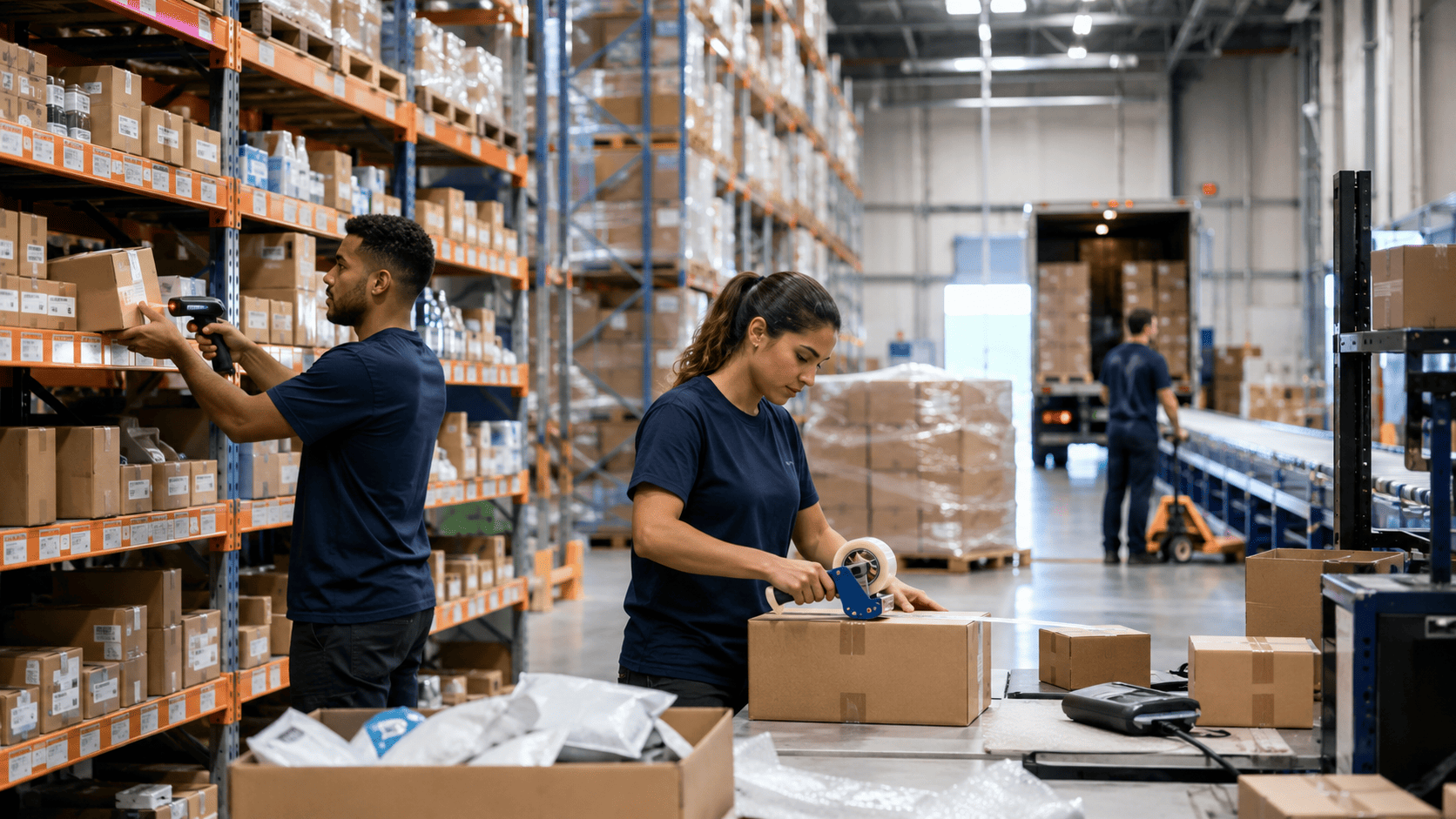
Retail fulfillment is the set of operations that moves a product from a storage shelf into the hands of the customer who ordered it. The difference between a smooth process and a leaky one shows up directly in your margin, ship times, and repeat orders. The work also gets harder as you scale: more channels, more retailer rules, more SKUs, not to mention that the operational climb gets steeper with every new account that comes in.
This guide breaks down the fulfillment meaning in retail, how the process works step by step, the channels and models involved, and how to build an operation that holds together as order volume grows.
TL;DR
- Retail fulfillment is receiving, storing, picking, packing, and shipping products so they reach the end customer or the retailer’s shelves.
- It comes with seven stages: the core process runs from inbound receiving through returns, and a weak link in any stage surfaces as a late shipment or an inventory error.
- Brands sell through physical stores, e-commerce, wholesale/B2B, and marketplaces, and most growing operators run several at once.
- Two models dominate: handling fulfillment in-house, or outsourcing to a third-party logistics (3PL) provider as volume outgrows your own space.
What Is Retail Fulfillment?
Retail fulfillment is the act or process of receiving inventory, holding it, then picking, packing, and shipping it when a sale happens. Retail order fulfillment describes the full path from the warehouse to a doorstep or a store shelf.
In practice, the term carries two related meanings:
- The first is consumer-facing: getting an individual order into a shopper’s hands, whether they bought online or in a store.
- The second is the vendor side: sending product in bulk to a retailer’s distribution center or directly to store locations, where it is then sold to consumers. A brand selling on its own website while also stocking shelves at a national chain is doing both.
So fulfillment in retail really means recognizing that the same inventory may leave your warehouse as a single parcel one day and a palletized retailer shipment the next, each with its own rules.
The Fulfillment Process, Step By Step
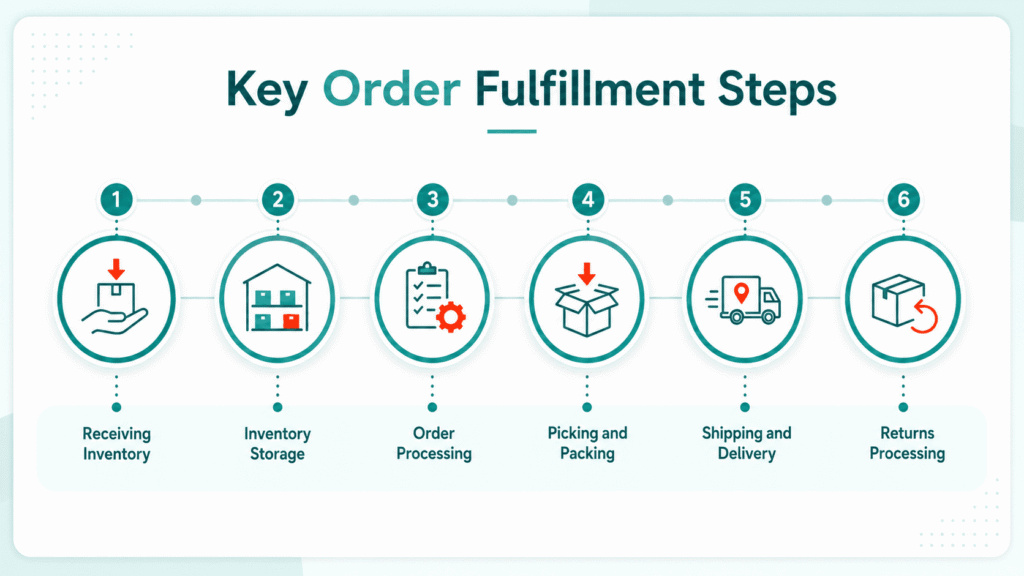
Most operations move through a familiar sequence, but performance is won or lost at the handoffs. When one link slips, the entire flow feels the strain. Let’s explain the fulfillment process, step by step:
- Receiving. Inbound stock is counted, inspected, and logged against the purchase order before it is put away. Accurate receiving is where inventory integrity begins.
- Warehousing. Product is slotted so it can be found fast, with reorder points set to prevent stockouts; the discipline at the heart of warehousing and distribution.
- Order processing. Often also called retail processing, this is where an incoming order is validated, payment is confirmed, and stock is allocated.
- Picking and packing. Items are pulled, verified by scan, and packed to the carrier’s or retailer’s specifications.
- Shipping. Orders move by parcel, LTL, or FTL freight depending on destination and size.
- Tracking. Tracking is shared with the customer or retailer, and the shipment is monitored through to delivery.
- Returns. Returned goods are inspected, then restocked, repaired, or disposed of; a flow known as reverse logistics.
⚠️ The handoff that breaks most often is receiving. Stock logged inaccurately on day one quietly distorts every count, pick, and shipment downstream.
What Are The 4 Types Of Retail Channels?
Few brands sell through a single channel anymore, and each one makes different fulfillment demands:
- Brick-and-mortar retail store fulfillment means delivering product to a store or its distribution center, packed and labeled to that retailer’s routing guide.
- Direct-to-consumer e-commerce orders ship as individual parcels from a fulfillment center, where speed and accuracy drive customer trust.
- Bulk B2B orders go to other businesses or big-box buyers, governed by strict compliance and vendor scorecards.
- Channels like Amazon FBA and other marketplaces add their own prep, labeling, and inbound requirements.
Running several of these at once is where omnichannel retail fulfillment comes in: one connected operation that keeps inventory, orders, and returns in sync no matter which channel a customer chooses to buy from.
In-House vs 3PL: Fulfillment Models
There are two common ways to run fulfillment, and the right one usually shifts as a brand grows.
| Model | Best For | Trade-Off |
|---|---|---|
| In-House | Early-stage brands, low order volume | Full control, but limited scale and rising fixed costs |
| 3PL (Third-Party Logistics) | Growing brands outpacing their own space | Less day-to-day control, but scalable capacity and better carrier rates |
Many brands start in-house for control, then move to a retail fulfillment center run by a third-party logistics (3PL) provider once order volume, SKU count, or retailer requirements outgrow a self-managed setup. A capable 3PL partner absorbs the operational complexity while you keep your focus on product and demand.
📌 3PL vs 4PL: A 3PL handles physical fulfillment; a 4PL coordinates multiple providers and manages strategy without holding inventory itself.
How To Build A Smooth Retail Fulfillment Process
A smooth operation is built before peak season, not during one. Five practices separate fulfillment that scales from fulfillment that buckles.
- Nail inventory accuracy. Everything downstream depends on knowing exactly what you have and where it sits. Double-scanning at receiving and picking keeps counts honest.
- Standardize compliance. Each retailer issues a routing guide with rules for labeling, packaging, pallet configuration, and delivery windows. Following them precisely keeps vendor scorecards green and avoids chargebacks. Most retailers still exchange orders by EDI (electronic data interchange).
- Connect your channels. When store, online, wholesale, and marketplace orders all draw from one source of truth, you stop overselling and mis-shipping. Connected e-commerce fulfillment systems are where the rubber meets the road.
- Plan the returns flow. Returns are not an edge case: the NRF projects that 19.3% of online sales will be returned. A defined reverse-logistics workflow recovers value instead of letting it sit on a dock.
- Right-size capacity. Aligning labor, space, and carrier capacity to actual order volume keeps cost per order under control as demand rises.
Build A Fulfillment Process That Scales
Strong fulfillment rewards operators who treat it as a system, not a series of one-off tasks. The brands that grow without chaos are the ones whose receiving, compliance, channel data, and returns all reinforce each other.
That is the operation Agile builds. We unify warehousing, pick-and-pack, multi-carrier shipping, retailer compliance, and returns under one disciplined process, with two-day dock-to-stock receiving and real-time inventory visibility, so orders move accurately whether they are headed to a doorstep or a big-box distribution center.
With a partner like Agile carrying the operational detail, reaching your next summit becomes a matter of selling more, not firefighting fulfillment.
Frequently Asked Questions
What Is The Difference Between Retail Fulfillment And Ecommerce Fulfillment?
Ecommerce fulfillment ships individual online orders directly to consumers. Retail fulfillment is broader: it also covers bulk, compliance-governed shipments sent to retailers’ distribution centers and stores, where the products are then sold to shoppers.
What Is A Retail Fulfillment Center?
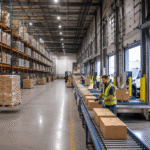
A retail fulfillment center is a warehouse built to receive, store, pick, pack, and ship retail orders. It combines inventory management, order processing, and carrier handoffs, and is often run by a 3PL on a brand’s behalf.
How Do Brands Avoid Retailer Chargebacks?
Chargebacks come from late, mislabeled, or incorrectly packed shipments. Avoiding them means following each retailer’s routing guide exactly, hitting the assigned delivery windows, and confirming labeling and pallet rules before the first order ever ships.
Can A Small Brand Handle Fulfillment In-House?
Yes, early on. In-house fulfillment gives full control at low volume. Most brands move to a 3PL once order counts, SKU complexity, or multi-retailer compliance make a self-run operation slower and costlier than it is worth.